Types of products#
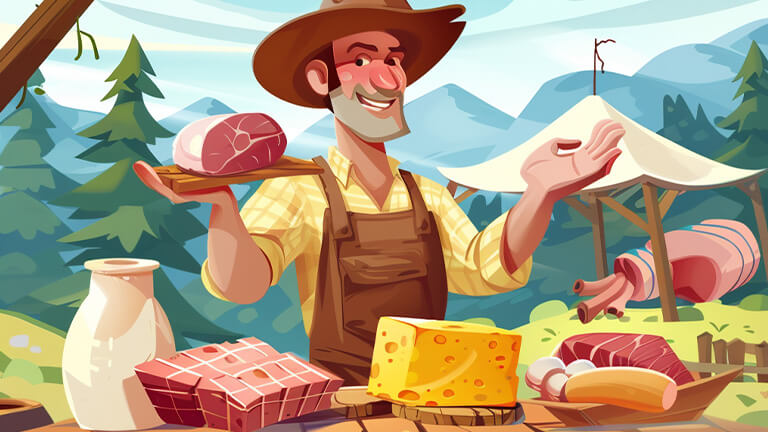
Cattle can generate several types of products and income: milk, beef, manure, calf hides, young animals (calves), state farm coupons, as well as income from the rental of breeding bulls and the sale of animals at fairs. In addition to their products, cows and bulls themselves are a commodity and can be sold for gold coins. The specifics of product yield depend on the age, weight, and sex of the animal. Cows and bulls weighing 350 kg or more can also be processed to produce calf hides. The main sources of income from cattle raising are discussed below.
Milk production#
Milk is one of the key products. To produce it, a cow must be between 61 and 420 days old and weigh at least 320 kg. Milk yield depends on the cow’s age and weight. The higher these figures, the more milk is produced. After reaching 420 days, a cow stops producing milk, so to maintain milk production, it is necessary to sire young animals in a timely manner.
Table. Milk yield for cows aged 61 to 240 days, provided an optimal feed ration.
| Cow weight (kg) | Milk at optimal feeding (l/day) |
|---|---|
| from 320 to 400 | 7.7 |
| from 400.001 to 450 | 8,085 |
| from 450.001 to 500 | 8.47 |
| from 500.001 to 550 | 8.855 |
| from 550,001 to 600 | 9.24 |
| from 600.001 to 650 | 9.625 |
| from 650.001 and above | 10.78 |
Table. Milk yield for cows aged 241 to 420 days, provided an optimal feed ration.
| Cow weight (kg) | Milk at optimal feeding (l/day) |
|---|---|
| from 320 to 400 | 5.5 |
| from 400.001 to 450 | 5.775 |
| from 450.001 to 500 | 6.05 |
| from 500.001 to 550 | 6.325 |
| from 550,001 to 600 | 6.6 |
| from 600.001 to 650 | 6.875 |
| from 650.001 and above | 7.7 |
Milk yield with incomplete feeding#
With a suboptimal feed ration, milk yield decreases proportionally to the feeding level. On days when a cow goes without feed, milk is not produced. For stable and maximum milk production, a complete and balanced diet is essential.
Beef production#
Beef is produced when cows and bulls are delivered to a butcher’s factory, regardless of the animal’s sex, age, or weight. The cost of processing one carcass is two gold coins. The largest volume of beef is obtained from processing adult animals of high weight.
The amount of beef produced depends on the animal’s age. Up to and including 75 days, the meat yield accounts for half the carcass’s weight. Between 76 and 480 days, the beef yield gradually decreases, reaching zero by day 480.
The amount of beef for animals over 75 days old is calculated using the formula:
\( W = m/2 • (480-A) / 405 \)where \( m \) is the weight of the animal at the time of processing, \( A \) is the age of the animal in days with a value of A > 75.
Cow manure production#
Cows and bulls of any age and weight produce manure. The amount of manure produced depends on the animal’s age and sex and is calculated based on optimal feeding.
Table. Manure production by cattle.
| Gender | Up to 60 days, kg/day | From 61 to 240 days, kg/day | From 241 to 420 days, kg/day | After 421 days, kg/day |
|---|---|---|---|---|
| Bull | Increasing from 0.1 to 28 | 32 | 25 | Decreasing from 21 to 0.5 |
| Cow | Increasing from 0.1 to 28 | 28 | 21 | Decreasing from 21 to 0.5 |
If the feeding is inadequate, the amount of manure produced decreases proportionally, and if there is no feed on a given day, no manure is produced. Manure can be processed into “Cow Breeze” fertilizer. To obtain 1 kg of fertilizer, 7 kg of manure and 0.002 gold are required. Having a cowshed reduces the cost of processing. Manure and fertilizer can be used for fields or sold at the market.
Production of calf skins#
Calf hides are a byproduct of processing livestock at a butcher’s factory. The cost of processing one carcass is 2 gold coins. The hides are obtained from animals weighing at least 350 kg.
Exchange of young bulls for state farm coupons#
Bull calves up to 60 days old can be donated to the state-owned farm’s nursery. Each bull earns one coupon per kilogram of body weight. Only bull calves are eligible for the exchange; heifers are not eligible. The state farm’s coupons can be used to purchase securities, produce premium feed, or sell on the commodity exchange.